Embedded Software in the Age of AI: Starting Over from Scratch
After 15 years in embedded development, I'm rebuilding everything from scratch — this time with AI. Here's why embedded still matters, what Edge AI changes, and what I'm building next.
Hi, I'm AI Craft Toby.
It's been a while since I wrote about embedded software.
A few years ago, I wrote a series explaining what embedded SW is, what an MCU does, and whether this field even has a future. Looking back at those posts, the core content still holds up.
But one thing has fundamentally changed.
AI is here. And I want to use it.
So today I'm revisiting the basics — and announcing a new project I'm genuinely excited about.
What Is Embedded Software?
"Embedded" literally means built-in. Embedded software is software that lives inside a machine, designed for one specific purpose and nothing else.
Take a washing machine. When you press a button, it washes, rinses, and spins — automatically. That's possible because there's a small computer inside called an ECU (Electric Control Unit). And inside that ECU sits a tiny black chip called an MCU (Micro Control Unit). The software that runs your washing machine lives inside that chip.
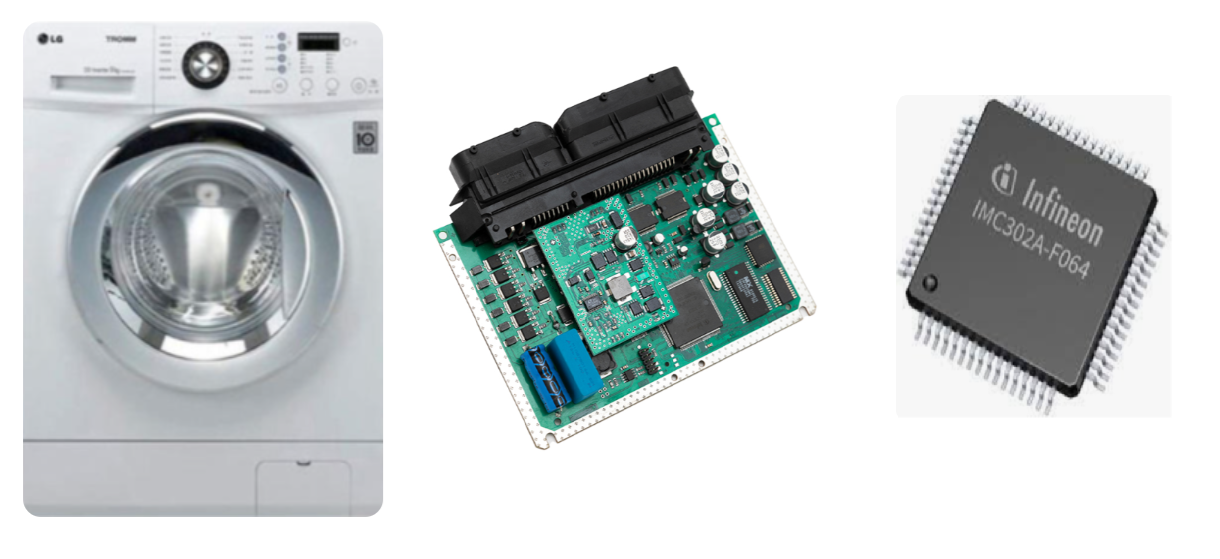
That's embedded software.
It's fundamentally different from the apps on your laptop. Your laptop runs Excel, YouTube, games — whatever you install. It's general-purpose. But embedded software does one thing only. It doesn't need a massive CPU or gigabytes of RAM. It just needs to be fast, reliable, and precise enough to do its job.
Embedded software is software built into a machine to control something specific — and nothing else.
What's Inside an MCU?
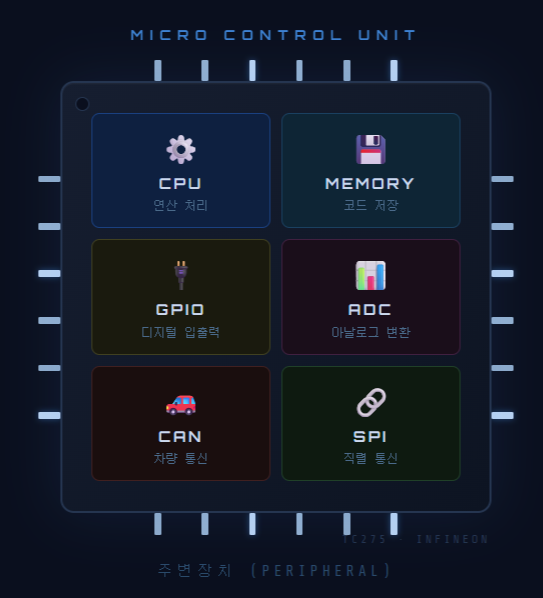
MCU stands for Micro Control Unit — a tiny, self-contained computer on a single chip.
Inside every MCU you'll find:
-
CPU — the brain that executes code
-
Memory — where the code is stored
-
Peripherals — specialized modules like ADC, SPI, CAN, and GPIO that handle real-world signals
Those peripherals are what make embedded software interesting. The washing machine maintains water temperature using ADC (analog-to-digital conversion). It controls spin speed through PWM signals. In a car, CAN (Controller Area Network) lets dozens of ECUs communicate with each other in real time.
Embedded software is ultimately about control — using these peripherals to make the physical world behave exactly as intended.
Will Embedded Developers Still Have a Job in the Age of AI?
I've been doing embedded development for over 15 years. I've asked myself this question more than once.
Is this field still worth it?
My answer: yes — and more than ever.
Here's why.
Embedded software runs in the physical world. When code is wrong, cars stop, airbags misfire, factory lines go down. AI can generate code, but someone still needs to verify that it works safely on real hardware. In automotive especially, standards like ISO 26262 mean that even AI-generated code requires human review and certification. That responsibility isn't going away.
The role is shifting, not disappearing. Where I used to write every register config and driver line by hand, the future looks like this: AI generates the first draft, and the engineer focuses on architecture, validation, and optimization. Repetitive work moves to AI. The harder judgment calls stay with humans.
The Biggest Opportunity: Edge AI
There's one more reason this field is about to get a lot more interesting. Edge AI.
Most AI today runs in the cloud. You send data to a server, the server runs the model, and you get a result back. That works fine for many use cases.
But imagine a self-driving car. If a person steps in front of the vehicle, there's no time to ping a server and wait. The chip inside the car has to make that decision instantly — in milliseconds.
That's Edge AI: running AI inference directly on the device, with no cloud dependency.
Tesla's FSD chip does exactly this. It processes camera feeds and makes driving decisions entirely on-board, in real time. Modern smartphones have dedicated NPUs for on-device AI processing. And increasingly, automotive-grade MCUs are being used to run lightweight AI models — what's called TinyML — directly on constrained hardware.
Here's what that means for the field.
There are plenty of people who can build AI models. There are very few who can deploy them safely on real hardware — respecting tight memory limits, meeting real-time deadlines, and satisfying functional safety requirements all at once. That combination takes years to develop.
AI knowledge + hardware knowledge = the rarest skill set in the industry.
High barrier to entry means fewer competitors. That's not a bad thing if you're already in.
So I'm Starting Over — With AI
I've spent the past year building web apps and a browser game using Claude Code. The workflow is simple: I describe what I want, AI writes the code, I review and steer. It's been surprisingly effective.
So I started wondering: what if I applied the same approach to embedded development?
That's the project.
I'm using an Infineon TC275 board and Claude Code to build an AI-Vehicle from scratch. The first goal: a small car that avoids obstacles in real time using infrared and ultrasonic sensors.
Every step — hardware design, peripheral setup, control logic — I'll be working alongside AI. I explain the theory. Claude Code generates the implementation. We run it on actual hardware and see what happens.
If you're learning embedded development, I hope this series makes the concepts more accessible. If you're curious about using AI beyond web development, this is going to be interesting territory.
Next post: Setting up the development environment — AURIX Development Studio and connecting the TC275 board. *
I'm an embedded software developer building AI-powered projects with Claude Code. Follow the journey at aicraftlog.com.
Related Posts
Stay Updated
Get notified when I publish new posts. No spam, unsubscribe anytime.